Sunday, June 1, 2014

THE HEAT IS ON - June 2014

                              by Fireweed, for the Island Word, June 2014 edition


Keeping a brick under a seat in your car during the warm summer months could come in handy.

SPCA HOTLINE: 1-888-703-7722
     Outrage over the recent deaths of six dogs from heat exhaustion in the back of a pickup truck here in B.C., Canada has been widespread. Faced with an emergency situation, it seems that plenty of people would be willing to act boldly on behalf of animals like Buddy, Teemo, Mia, Salty, Oscar and Molly. “Just snap a picture with your phone and call 911 before you break a window,” advised one dog lover on an online news site covering this sad story. Proof of life-threatening distress, her comment implied, would legitimize resorting to property damage.


      The law, of course, may not necessarily see things that way. And in spite of the fact that virtually every jurisdiction in North America has laws that say animals should be treated humanely and not be made to suffer unnecessarily, Canadian lawyer Lesli Bisgould says, “These laws really don't provide protection for animals from human-caused suffering in any meaningful way.”  Now it's not that the BC SPCA hasn't recommended that criminal charges be laid in the deaths of the six dogs. And hopefully a conviction will result based on unnecessary suffering leading to death. But Bisgould points out that a lack of rights for animals means that when the law prohibits 'unnecessary' suffering it creates a 
corollary - meaning it permits us to cause whatever is considered to be 'necessary' suffering and then protects those activities when it comes to a staggering number of animals under human care. Since we “write the law, interpret the law and enforce it,” Bisgould explains in her 2014 University of Toronto Tedx Talk, it turns out that it's necessary for an animal to suffer pretty much “whenever we say so.”


       Due in part to pressure from the animal agriculture industry, for example, the criminal code has barely changed in regards to animal cruelty laws in Canada in more than a century. Over 700 million animals are intensively confined here by agribusiness every year. They are subjected to routine practises deemed 'necessary' that would never be tolerated by an aware general public if inflicted upon our beloved dogs. So depleted by their ordeal by the time they are packed onto transit trucks destined for the slaughterhouse, several million un-named individuals arrive there already dead. Bisgould reminds us that for the most part this industry writes its own guidelines and that there is very little government oversight. She asserts that for every story we hear in the news about some atrocity done to a companion animal, “there is an industrial counterpart where that violence is normalized and multiplied by hundreds or thousands or millions of times.”

       Moving away from the factory farm model towards smaller scale animal husbandry operations is commonly lauded as a major step in the right direction. But while in this day and age most of us concede that so-called 'farm animals' experience pain, fear, joy and a desire for freedom – a lot like the companion animals we prefer to spare from an early death - we remain reluctant as a society to abandon centuries-old laws that categorized all animals as mere 'things.' In spite of the fact that non-sentient entities like corporations, churches, and even ships have been granted 'personhood' under the law so that they may be recognized as individuals with certain protective rights, the legal status of animals as 'property' here in Canada persists so that they remain powerless - and the humans who would use them may do so freely under the rule of law.

       Regardless of how animals are raised, as long as we insist on exploiting their bodies we are reinforcing an industry that guarantees enormous suffering. In “The Dilemma of Humane Execution and Humane Slaughter,” author and Cornell law professor Sherry F. Colb reflects on the fact that even human executions in US prisons are predictably botched on occasion even though each human is executed singly. With over 55 billion land animals slaughtered around the world every year, the sheer volume and speed involved translates into an enormous number of torturous deaths. Colb goes on to acknowledge that while reducing the appearance of suffering in slaughter has the effect of relieving consumer discomfort, it ironically generates more suffering for animals by spurring demand. In contrast to what some farmers would have us believe, she concludes that marketing the concept of “humane” measures for animals is likely to prove more harmful than helpful to animals over all.

Jeffrey Cohan, executive director of Jewish Vegetarians of North America puts it this way, “The reality is, you will never hear spokespeople for the industrial-livestock companies criticize or complain about the 'humane' meat movement. And there's a reason for that. The 'humane' meat movement is perpetuating the idea that it's perfectly OK to kill young animals if you like the way their flesh tastes. And in so doing, the movement is sustaining the industry.”

      As a leading source of GHG emissions, water depletion and rainforest destruction, animal agriculture is responsible for cranking up the heat for domestic and wild animals alike. The good news is that shifting to a plant-based diet offers an immediate means of reducing unnecessary suffering in multiple ways. And it's never been easier to find support for transitioning away from unnecessary reliance upon animal agriculture. Feel free to kick the heat up in the following delicious vegan chickpea curry recipe! Visit past columns in The Transition Kitchen blog to access additional recipes, links, and lots more climate-friendly, animal-friendly food for thought.          
  
                                                     ***

FOOTNOTE: I should add that when doing research for this article I learned - not surprisingly- that neither the BC SPCA nor the local RCMP recommends vigilante action on behalf of dogs in hot cars. Both institutions are permitted to break a window as required whereas other folks might end up being charged by the owner of the vehicle for damages. Surely the more likely scenario is eternal gratitude for saving a loved one…especially when time is of the essence. The hotline for the SPCA throughout BC is 1-888-703-7722.


Fireweed's Vegan Garbanzo Curry
edible  kale flowers for decoration 

Ingredients:

1 can organic whole Italian plum or diced tomatoes
1/2 a small onion
1/4 cup raisins
1/2 tsp finely chopped garlic
1/2 T olive oil
1/2 organic herbal veggie bouillon cube (optional)
1 T organic lemon or lime juice
2 cups canned or home-cooked organic chickpeas
1/2 T (or more to taste!) PATAK brand curry paste (Madras is my fave)
a pinch of stevia, or drizzle of maple or agave syrup to taste
salt, pepper
Optional: steamed or oven roasted cauliflower, chopped spinach, kale or other greens

Directions:

Chop onion and sautee in olive oil until lightly browned in a large skillet, add tomatoes, veggie bouillon, garlic and chickpeas with all liquids; season to taste with curry paste, salt and pepper; add sweetener and raisins. Cook gently over medium heat, stirring to avoid sticking until sauce thickens a little. Add optional items, cover the pan to wilt greens over low heat, and serve over either brown rice, cous cous, polenta or quinoa. Bon appetit!

Wednesday, April 2, 2014

FOOD FOREST GARDENING - APRIL 2014


                                   -by Fireweed, for the Island Word, April 2014 edition

     Throughout wetlands and along stream banks here in the Pacific Northwest, a large yellow flower is currently holding court. Even the leaves of the majestic skunk cabbage are bigger than anything you'd expect to find outside of a tropical rainforest! Its showy presence has affirmed the return of spring in this region for millenia.

Daffodils and lambs are also considered synonymous with the month of April on the island where I live, but these additions to the rural landscape are still relatively new. Daffodils originated in parts of Europe and Africa. Sheep, too, arrived with the first Europeans to settle here. That happened only about 140 years ago - at least 5,000 years after the Coast Salish people are known to have first visited these shores in search of food.

Skunk cabbage isn't good for eating, but its waxy leaves are ideal for drying berries. According to ethnobotanist Dr. Nancy Turner, approximately 100 species of plant foods were once harvested by the First Nations inhabitants of coastal British Columbia. For various reasons, the majority are no longer in use. Including fruits, greens, inner bark, beverages and root vegetables, these traditional foods have been among the most hugely impacted by colonization.
 
 Only a century ago in Kingcome Inlet, for example,
camas bulbs

Tsawataineuk women were still cultivating root gardens of silverbank clover, Pacific silverweed, northern riceroot and Nootka lupine, when a man named McKay decided to fence off the land and deny any further access. Also reported (in 1914) by Hereditary Chief Cesaholis to  the Royal Commission on Indian Affairs for the Province of BC, Pacific crab apple trees that had provided another source of food well-suited for over-winter storage were cut down by settlers. Additional elimination of traditional root-digging grounds came about through the introduction of imported livestock.

....and then the animals of the whiteman, such as the pigs and cattle would come and eat it off, and then my forefathers and the women got tired and gave it up when they saw their food was destroyed by the cattle...” (Cesaholis 1914)

One hundred years later, the US-based Centre for Biological Diversity has just unveiled a brand new project called Take Extinction Off Your Plate. It highlights the fact that animal agriculture has become one of the main drivers of environmental destruction world-wide and calls for an immediate reduction in flesh consumption. Substituting dairy or eggs for meat is discouraged, and so is simply switching to “grass-fed” beef. Studies have shown that grass-fed cattle are responsible for far more greenhouse gas emissions than grain-fed animals – as much as 500 percent more. With over seven billion people on the planet and counting, meat production has already tripled over the last 30 years alone and could double again by 2020. The Centre for Biological Diversity's message is urgent: “there are too many people eating too much meat for any form of meat production to be considered sustainable.”

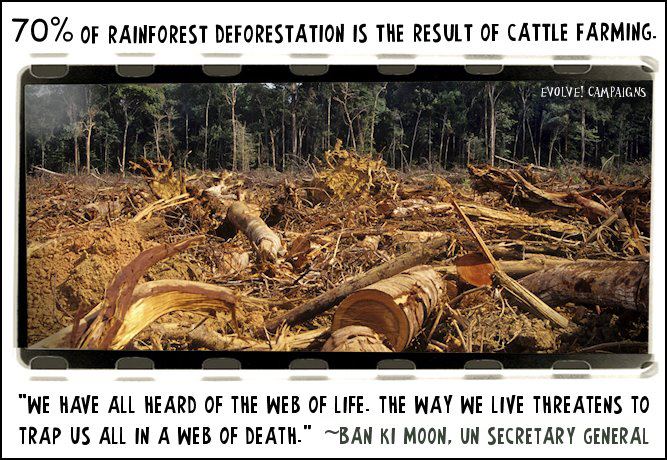
Commonly referred to as the lungs of the earth, the Amazon Rainforest continues to disappear at an alarming rate (the cleared land there is used mostly for cattle ranching and crop cultivation - including soy for animal feed.) But over half of Vancouver Island's old-growth is now gone as well, and even the BC government admits that our forests have been emitting rather than storing carbon for the last ten years. Proposed changes to BC's Agricultural Land Reserve could further reduce biological diversity and exacerbate global warming by opening the door to even more potential oil and gas development.

     Today's locavore movement must begin to take a far greater interest in ensuring future food security through transitioning away from animal-based farming towards better use of existing arable land - for the growing of crops intended to feed people directly. On top of being more climate-friendly, a plant-oriented diet uses five to seven times less land than an omnivorous one, and also saves nearly 600 gallons of water per day in comparison. Examples of successful stock-free growing operations that likewise conserve these valuable resources are finally beginning to gain mainstream recognition.

According to Aviram Rozin, founder of Sadhana Forest, water conservation and reforestation are the main ecological issues of the 21st century. Global warming poses a particularly huge threat to food security in India, for example, where over 1.2 billion people are at the mercy of increasingly severe droughts and monsoon flooding. Over the past ten years Sadhana Forest India has attracted thousands of volunteers from around the world to help heal 70 acres of severely degraded land in southern India the stock-free way. They have focused on bringing back a tropical dry evergreen forest from the brink of extinction by planting 29,000 indigenous trees, and implementing water retention methods that have increased the local aquifer by 20 feet! “Greening the planet from the grassroots,” the aim of Sadhana Forest projects (now expanded into Haiti and Kenya) is to “introduce a growing number of people to sustainable living, food security through ecological transformation, wasteland reclamation, and veganism.”

Food forests were actually an ancient means of securing sustenance in the tropics (along with fibre, tools and more), that we might think of today as “Gardens of Eden.” Designed to mimic self-sustaining, multi-storied indigenous ecosystems, they are abundant in edible plant growth from the ground up through at least seven layers into the canopies of mature fruit or nut-bearing trees. In the 1960's, food forestry principles were adapted to Britian's temperate climate by the late master gardener Robert Hart, a longtime vegan pioneer in the UK. An exciting North American example is the seven acre Beacon Food Forest just south of the Canadian/Washington State border. Free public foraging of healthy food is available on the honour system to the surrounding Seattle community. Abundant living in the coming age of the tree* is indeed here for the planting!

                                                               …………

* “Abundant Living in the Coming Age of the Tree” was an ecological treatise published in England in 1991 by veganic pioneer Kathleen Jannaway. Visit the LINKS list for April 2014 on the right hand side of this page for more. Be sure to check out Robert Hart HERE To read other posts on The Transition Kitchen blog, click HERE  and you'll be able to scroll down for more:)                                            


Stinging nettles are a wild local edible in the Cascadian bioregion. They make excellent fertilizer for the garden, can be dried as an iron-rich medicinal tea, and even spun into twine. Alongside skunk cabbage and salmonberry blossoms they are another harbinger of spring in my local watershed that will hopefully be here forever. They also happen to make awesome spanakopita!

                                Fireweed's Nettle Spanakopita (makes approximately 6 servings)

Ingredients:
1/2 cup (at least) lightly steamed stinging nettles (pick only the top tender leaves to avoid stalks...or alternatively use fresh or thawed frozen spinach, since you do need to pick lots of nettles)
1 block (16 ounces) organic medium tofu (squeeze out water and crumble into bowl)
1/3 cup nutritional yeast (available at Edible Island)
2 Tablespoons dark or light miso (add more to taste)
1 clove garlic, crushed and finely minced
1/8 cup carmelized onion (sauteed over low heat in a little organic olive oil)
sea salt and ground black pepper to taste
1 Tablespoon pine nuts (optional)
6 sheets of organic whole wheat phyllo pastry (or more)

Fireweed's Nettle Spanakopita

Directions:
Combine crumbled tofu with nutritional yeast, miso and garlic really well by hand or lightly pulse together in food processor. Remove and fold in remaining ingredients (except nettles and pastry sheets!) Season to taste. Press liquid out of cooled, steamed nettles, chop fine, and evenly distribute into tofu filling. Brush your first sheet of phyllo lightly with a little olive oil and fold it in half lengthwise. Brush again, and spread 1/3 cup mixture across one end. Flatten a little so you make a rectangle of sorts. Brush exposed edges of the phyllo and tuck in as you fold/roll up the filling, continuing to lightly brush each layer until complete. Repeat with each sheet until you're out of filling. Place your spanakopita gently on a non-stick cookie sheet or lightly-oiled alternative surface and bake at 375 F for 12-15 minutes or until barely golden brown (you could turn up to 425 F for a few more minutes to help with browning.) Cool on cookie racks. Reheat before serving. Bon appetit!
Tuesday, February 4, 2014

HEART TO HEART - February 2014

                                                                     by Fireweed, for the Island Word, February 2014 edition

   
 “It is only with the heart that one can see rightly…”
~ Antoine de Saint-Exupery

According to legend, Valentine's Day originated with a miracle in ancient Rome. A Christian priest by the name of Valentine was imprisoned and condemned to death for his unwavering religious beliefs. While awaiting his fate, Valentine is alleged to have cured his jailer's daughter, Julia, of her blindness. One version of the story tells us that the night before his execution he sent the young woman a farewell message signed, "Your Valentine." An embellishment to the tale (likely added centuries later) includes Julia planting a flowering almond tree near the martyr's grave. And so to this day the almond tree remains a symbol of abiding love and friendship!

      Of course, it is the nature of legends to evolve - with colourful 'new' details adapting them to time and place. Even the shape now commonly identified as a valentine heart is most likely a composite of earlier symbols and meanings now obscured by the mists of antiquity. Scholars point to stylized depictions of female anatomy as well as leaves, flower petals, and early renderings of pine cones and seeds as possible predecessors. It wasn't until the 14th century (and the poetry of Geoffrey Chaucer) that Valentine's Day and its now popular emblem were associated with romantic love.

    Besides the crescent moon and the cross, however, no symbol is more widely recognized on the planet today. It has indeed been co-opted by crass commercialism. But as an expression of love, warmth and approval, the contemporary heart motif is understood to represent harmony and goodwill. It also remains emblematic of the muscle that pumps blood through our veins and oxygen to our brains. Perhaps we would do well to imagine its ubiquitous presence in our modern world as a reminder of the vital connection between mental health and physical well-being! What is necessary for the soul is certainly vital to the body.

     Without heart-centered relationships - without compassion for self and others - we simply do not thrive. February is Heart Month in the US, Canada and the UK where cardiovascular disease remains a leading cause of death for both men and women. General medical consensus has it that stress reduction goes hand in hand with a whole-foods plant-rich diet, sufficient exercise, and other healthy lifestyle choices when it comes to avoiding the risk factors that can lead to heart problems. 

     According to the Harvard Mental Health Letter (Feb. 2006), "Mind and mood affect the cardiovascular system directly by creating a state of emergency readiness, in which stress hormone levels rise, blood vessels constrict, and heartbeat speeds up. If a person is seriously depressed or anxious, the emergency response becomes constant, damaging the blood vessels and making the heart less sensitive to signals telling it to slow down or speed up as the body's demands change."   

     Along with practicing empathy in our human relations, opening one's heart to animals has become well established as highly beneficial to health enhancement. A ten year study through the University of Minnesota's Stroke Institute in Minneapolis concludes that cat caregivers showed a remarkable 30 per cent lower risk of death from heart attack compared to those without feline companions in their lives! Simply petting a cat or dog has been shown to reduce stress and decrease blood pressure significantly


     Recognizing the value of the human-animal bond is leading more and more people to reconsider the nature of their relationships with animals of all kinds. For example, since Ontario couple Derek Walter and Steven Jenkins decided to add a pig to their family which already included cats and dogs in 2012, the notion that animals exist in separate categories as either 'friend or food' no longer holds true for these former meat-eaters. 

     Currently weighing in at over 375 pounds, Esther the Wonder Pig is gaining renown as an internet sensation. Her caregivers mistakenly believed they were adopting an unwanted mini-pig at the time, not rescuing an animal destined for the slaughterhouse! In a matter of days both men knew they could never eat bacon or pork again. They set out to educate themselves about the animal agriculture industry and transitioned to veganism as a result.
  
    The joy of experiencing Esther grow into a playful, affectionate, highly intelligent animal prompted the creation of a Facebook page for sharing videos and photos with friends and family last December. Walter and Jenkins could never have imagined that in less than two months time over 81,000 Facebook fans would help their story (and Esther’s) go viral! The two men hope to eventually open a sanctuary for pigs. In the meantime they are taking advantage of the spotlight to raise awareness about the problem of commercial pet pig breeding (here in BC, Hearts on Noses Sanctuary in Mission can use our support). Walter and Jenkins have also become advocates for the benefits of a heart-smart vegan diet - first and foremost out of respect for the lives of other sentient beings like Esther. 

    
      Fortunately, there is nothing human beings with the privilege of choice require for optimum health from other animals. And our heart health certainly benefits from avoiding the cholesterol and saturated fat found only in animal products. Monounsaturated and polyunsaturated fats are the good ones and they are easily sourced from plants like avocados, nuts and seeds. In the spirit of Valentines Day, here's a slightly decadent but super simple, gluten-free vegan cookie recipe to share with the sweethearts in your life! (Thanks to Shae, who believes that gratitude, compassion and love will change the world. )

Shae's Chewy Almond Butter Cookies 

Ingredients:
1 cup organic almond flour
1/2 tsp baking soda
pinch of salt
1/2 cup organic almond butter
1/4 cup maple syrup

Directions:
Preheat oven to 350 degrees F. Add all dry ingredients to your food processor and pulse into a fine powder. Add the almond butter and maple syrup and process to combine into a dough. Using a tablespoon, measure the mixture into 15 cookies. Roll into balls and press onto cookie sheet, flattening with your fingers. Alternatively, roll out the dough (not too thinly) and cut using a small heart-shaped cookie cutter. Bake time is only 7 minutes, or until golden brown, so stick around!

                                                                  …..

For references highlighted in this article, past columns, recipes and more, please visit the links lists on the right hand side of this page!


Tuesday, October 29, 2013

SPILLED MILK - November 2013

         by Fireweed, for the Island Word, November issue, 2013 

A short time ago in Newbury, England, the local police department started receiving late nite inquiries about a most unnerving noise. It happens every year at the same time, Sgt. Patty Fisher told the Newbury Port News , but there's nothing spooky or scary going on.” The strange sounds come from the nearby Sunshine Dairy Farm, she explained,and are a normal part of farming practises.” The mothers are separated from their calves almost immediately after birth in order to prevent them from nursing. Concerned callers, reported the Daily News, are advised to simply “expect loud noises from the cows at any time of the day or night.”

It's heart-breaking but instructive to recognize that the haunting bellows of a grieving mother cow communicate  imposed suffering. More and more people are re-considering conventional food choices, and calling into question so-called “normal farming practises.” For many, realizing that there is nothing 'humane' about denying a cow's maternal instinct to bond with her babies is an important first step in the transition to a more compassionate diet.

Meanwhile, industry marketers remain busy distracting their consumer base away from the many uncomfortable 'details' that dairy production entails (forced impregnation, mastitis, downed cows, veal calves, green house gas emissions, heavy water use, etc.) Their job is to convince an increasingly doubtful public that consuming the milk of another species remains desirable and necessary.

Remember the “Got Milk?” campaign, featuring stylish portraits of celebrities sporting milk moustaches? Advertising gimmicks have included promoting milk consumption as integral to building strong bones, as a cure for premenstrual syndrome (PMS), and even as an aid for weight loss. As investigative health journalist Martha Rosenberg writes in “Got Propaganda? Why All of the Milk Industry's Health Claims Have Been Proven Wrong” (Alternet, 2012), each of these campaigns has been reprimanded by independent health professionals. In the USA, the Federal Trade Commission's Bureau of Consumer Protection has demanded that the industry stop making misleading claims.
Rosenberg points out, for example, that ads designed to elevate dairy over calcium-fortified juices - a chief competitor for consumer dollars- have been brazenly contradictory. Did they think no one would notice that the very study they based their promotion of milk upon as a 'cure' for PMS actually credited calcium (not milk) with providing the alleged relief? Sufficient calcium is easily acquired without dairy products of any kind in one's diet since it is found in such a wide variety of food sources (oranges, kale and other leafy greens, almonds, broccoli, blackstrap molasses, white beans, dried figs, tofu, tahini, fortified juices, and more.)

An attempt in 2011 to employ the PMS angle again - this time with a failed sense of humour - involved ads that stereotyped women as 'always right' and men as 'always wrong.' Bumbling husbands and boyfriends were portrayed bringing home cartons of milk to supposedly placate their partners during that 'difficult' time of the month. The ads were pulled in a matter of days as an outraged female demographic cried foul over the sexist messaging. Perhaps it shouldn't be surprising that an industry predicated upon manipulation of the female body (in the form of cows' reproductive capacities), also sees economic potential in exploiting a woman's concerns with her own hormonal cycle.

In reality, the human body has absolutely no requirement for dairy products (nor the milk of any other species beyond our own) and an estimated 75% of the world's population is lactose intolerant! Cows milk consumption has actually been on a steady decline for many years (prompting the heavy push to keep people hooked), and today we find any number of tasty non-dairy milk alternatives on the shelves of popular grocery stores. It's not difficult to make homemade varieties but the convenience of commercially available organic soy, rice, oatmeal, coconut, quinoa, hemp, almond, cashew and other milks is certainly attractive. How to choose? It can take our taste buds a month or so to adjust to new flavors and stop comparing everything to the old familiar. So it's best to cleanse the palate by not switching back and forth between cow's milk and new alternatives while experimenting.

Far more challenging for many folks is giving up dairy cheese...and understandably so. The emotional addictions we develop to certain foods are often chemically based. “Casein, one of the proteins in cow's milk,” explains author Victoria Moran in “Main Street Vegan, "crosses the blood-brain barrier and becomes something called casomorphin” (an opoid, not unlike morphine.) Naturally designed to keep calves happily nursing and coming back for more, casomorphin is even more heavily concentrated once milk is turned into cheese. It can help to remember that we're not baby cows, and are no longer willing to be complicit in their fate.

Understanding the nature of our cravings is certainly the first step to releasing their hold over our taste preferences. Most of us are attuned to the classic four: sweet, salt, sour and bitter. But “umami,” or “savory,” says food writer Jennifer Valentine, is an often-overlooked taste experience commonly associated with animal products...like aged cheese. She suggests eating fermented foods, which are high in umami flavor, as one way to boost the “savory factor.” Mushrooms, miso, balsamic vinegar, tomatoes, and potatoes are also 'umami-friendly.'

Consumer demand for dairy alternatives is creating a food revolution. In Germany's all vegan foodstore chain “Veganz", shoppers can now peruse 80 different varieties of 100% plant-based cheeses! North American stores are finally beginning to increase their selections of this item, and people are also learning how to make their own. Check out my super easy recipe below for a creamy, cheezy spread including miso – a fermented condiment that practically sings 'umami'! Cheeze Louise also makes a delicious filling for spanakopita or lasagna.

Please visit the links list on the right hand side of this page for highlighted references, recipes and more! 

Cheeze Louise

Ingredients:
1 block medium firm organic tofu (350 grams)
1 cup raw, unsalted cashews (soaked 8 hours or overnite)
1/4 cup nutritional yeast
2 T. light or dark Miso (your choice)
1/2 tsp. organic lemon juice (fresh or bottled)
1/2 tsp. sea salt, dash of pepper
Optional:
dill, carmelized onions, pine nuts

Directions:
Press, or squeeze excess water from the tofu, drain the cashews and pat dry. Place all ingredients (except for the optional items ) in a food processor. Blend until creamy. Depending on the tofu, you will need to stop and start, removing the mixture from the blade and/or sides of the bowl with a spatula. Thin with another 1/2 teaspoon of lemon juice if very thick. Depending on the intensity of the miso, you may also want to add a wee bit more salt. Refrigerate for a couple of days in a glass jar to allow the flavors to deepen…patience is a virtue here, and this spread will easily last a week. 

To use the mixture as a filling for spanakopita right away, omit the lemon juice if your food processor will blend the ingredients without it, remove to a new bowl, fold in a T. of fresh dill (or 2 tsps.dried), 1/4 to 1/2 a cup of carmelized onions (sauteed ahead of time in a little olive oil over low heat until browned, and set aside to cool), and 2 T. pine nuts. Combine with a generous amount of fresh chopped spinach (or well drained frozen spinach) and spread on phillo pastry brushed with olive oil to roll or fold into individual spanakopita. Bake on a dark cookie sheet at 425 F until golden brown (about 10 minutes…maybe 15), and enjoy! 

Happy Celtic New Year:) 

To read the article I wrote for this time of the year in 2012, please click here: http://www.thetransitionkitchen.blogspot.ca/2012_09_01_archive.html


Tuesday, September 3, 2013

SOWING FOR SUSTAINABILITY - September 2013


                                          by Fireweed, for the Island Word, September Issue, 2013


     The word sustainability is used with increasing frequency these days but what does it actually mean?

     In an ecological sense we know that biological systems like forests and wetlands must support a diverse network of life-forms to remain healthy and 'productive' over time. For human beings however, sustainability is generally understood to be a reconciliation of perceived economic needs and social equity, in addition to environmental needs.

     As Michael R. Redclift writes in 'Sustainable Development (1987-2005) - An Oxymoron Comes of Age,' sometimes people define their 'needs' in ways that effectively exclude others from meeting theirs. In the process this “can increase the long-term risks for the sustainability of other peoples' livelihoods.”

     More importantly, Redclift adds, “the process through which we enlarge our choices, and reduce those of others, is largely invisible to people in their daily lives, although understanding this process is central to our ability to have more 'sustainability.'”

     Dr. Richard Oppenlander, author of Comfortably Unaware (2011) and “Food Choice and Sustainability” (2013) is dedicated to exposing the massive impact our collective dietary choices are having on what he refers to as “global depletion.” Locavorism (basing one's diet  as much as possible on food grown within an approximately 100 mile radius) has been popularized as a fitting response to food security and fossil fuel scarcity concerns here in the West for those with the privilege of choice. However, Oppenlander illustrates that what we eat is just as significant and often more so than so-called food miles. As long as we remain wedded to animal-based agriculture he points out, we are failing to address the all important 'big picture.'

      There are over 7 billion people on the planet today and over 70 billion animals are raised each year to feed them. Loss of biodiversity, water scarcity, agricultural land use inefficiencies, habitat loss, the state of our oceans, world hunger, and the sustainability of our own health are not simply a factory farming issue. “The problem,” Oppenlander explains in his presentations, “is a 'raising animals to eat' issue.”

      There are an estimated one billion people suffering from hunger today and at least six million children die annually from starvation. 82% of these children live in countries where food surpluses are fed to animals that are then killed to be eaten by more well-off individuals in developed countries. “Of course world hunger has many layers of complexity,” says Oppenlander. But the looming shadow of our current demand to eat livestock and fish is tied to poverty because consumer demands affect food prices, food availability, food policy making and even education to 'improve' agricultural systems in developing countries which are becoming increasingly locked in to animal agribusiness.

      Oppenlander stresses that suppression and mismanagement of this problem has only aided the failure of climate change summits to advance important target goals. It really won't matter how many hybrid cars we switch to or how many lightbulbs we change out if we don't change what we see on our plates, he admonishes. 

      The UN FAO (Food and Agriculture Organization) recognizes that animal agriculture contributes more GHG (Green House Gasses) to the atmosphere than all transportation combined. And it's well worth noting that studies comparing the methane emissions from grazing and feedlot cattle have found that grass-fed cattle produce abut 4 times more methane than grain-fed cattle (Journal of Animal Science.)

     According to the Environmental Working Group, if everyone in the US alone ate no meat or cheese just one day a week, that would be like taking 7.6 million cars off the road. But Oppenlander rightly questions why those serious about sustainability would choose to limit themselves to “baby steps.” The threat of runaway global warming, for example, requires an adult response. Reducing GHG emissions on Monday doesn't make it OK to keep contributing to the problem six other days of the week when it is well within our means to avoid doing so.
   
      The good news is that whether you're just warming up to the idea of shifting your diet away from reliance on animal products, or ready to be part of the growing movement calling for widespread dietary reform, more and more major public interest groups are providing encouragement.  The Union of Concerned Scientists (UCS), for example, points out that "the best way to take a bite out of climate change is to reduce meat consumption, especially beef."  And according to their new US stats-based 2013 report, The $11 Trillion Dollar Reward, an increase in the consumption of fruits and vegetables would save more than 100,000 American lives and $17 billion in health care costs incurred from heart disease annually. As we've seen, we really must go much further than simply cutting back on beef. Of course it makes perfect sense to keep supporting local farmers' markets wherever we live in the world... as long as we're loading up on plant nutrition choices.
     
     
SPUDS Co-op practises stock-free growing
     SPUDS (Sowing Potatoes Underground for Denman Sustainability) is the name of a small local food security co-op in my rural island community off the west coast of British Columbia, Canada. Recently we harvested our best crop yet from land we've been tending collectively without the use of any animal inputs whatsoever for the past six years. The stock-free growing techniques we use instead include crop rotation and sowing green manure cover crops like clover, vetch and over-wintering pea to feed the land directly - there is absolutely no need to first pass these plants through the body of an animal to promote soil fertility. Just as there is no need to eat animals when the nutrients our bodies require for optimum health can be obtained directly from plants.

     While SPUDS co-op membership is diverse and our dietary persuasions vary, we all love our potatoes. At harvest time I can't help but reflect on the plight of my own ancestors and the role of the potato in their lives. Prior to the Great Famine in Ireland, colonization by the British pushed peasant farmers off the best pasture land. I know that on one acre of land with good soil and irrigation it's possible to grow at least 100 times more pounds of potatoes for human consumption than pounds of beef. But the natives in Ireland were replaced by beef cattle destined for export that eventually took over most of the countryside. This peasant population was forced to depend on the only potato they had to grow on the marginal lands available – the Irish Lumper. When the potato blight arrived (most likely by ship from the eastern seaboard of the USA), the devastation of this monocrop led to death by starvation and disease of a million men, women and children.

     Sometimes we are slow to learn from the lessons of the past, but collectively we do have the power to help transition our global food systems in a far more sustainable direction. Slainte! (“To your good health!” – Irish Gaelic)

SPUDS Co-op, Denman Island, BC, Canada 2013

Fireweed's Vegan Organic Potato Pate

This recipe makes a delicious sandwich filling, or tasty appetizer on crackers. I've even used it to stuff dolmades, and baked mushroom hors d'oeuvres!

3 cups grated peeled raw organic potato (press out liquid)
1 cup raw sunflower seeds (organic unsalted)
1/4 cup spelt flour (or gluten-free quinoa flour)
1/4 cup nutritional yeast
1/2 onion, finely chopped
1 lemon (just the juice)
2 tsp. dried basil
2 tsp. dried oregano
2 tsp. dried dill
1 tsp. sea salt
2 T. organic sunflower oil
black pepper
sesame seeds
optional: leave out salt and add 1/2 an herbal veggie bouillon cube

Combine all ingredients in a food processor and blend until well mixed but still 'grainy' (you don't want a batter.) Adjust seasonings to taste then spoon into an oiled pan with parchment paper on the bottom. Smooth surface with the back of a wet spoon or spatula. Sprinkle with additional herbs and sesame seeds. Bake for 40 minutes (or more, depending upon the depth of the pan you use) and cool before cutting. Best served at room temperature or chilled. Spread on rice crackers and top with pickle or serve on crusty bread in a sandwich. Bon appetit!

For links related to 'Sowing Sustainability', including a few more tasty potato recipes,  please look for September 2013 RELATED LINKS on the right hand side of this page.


Note: "Sowing Sustainability" has been slightly modified from its original version in 'The Island Word'. For other articles by Fireweed for The Transition Kitchen, please scroll down or visit the blog archive on the right hand side of the page. You might have to access the main page by clicking here:  www.thetransitionkitchen.blogspot.ca  Feel free to share…thanks!